 Gordon Setter
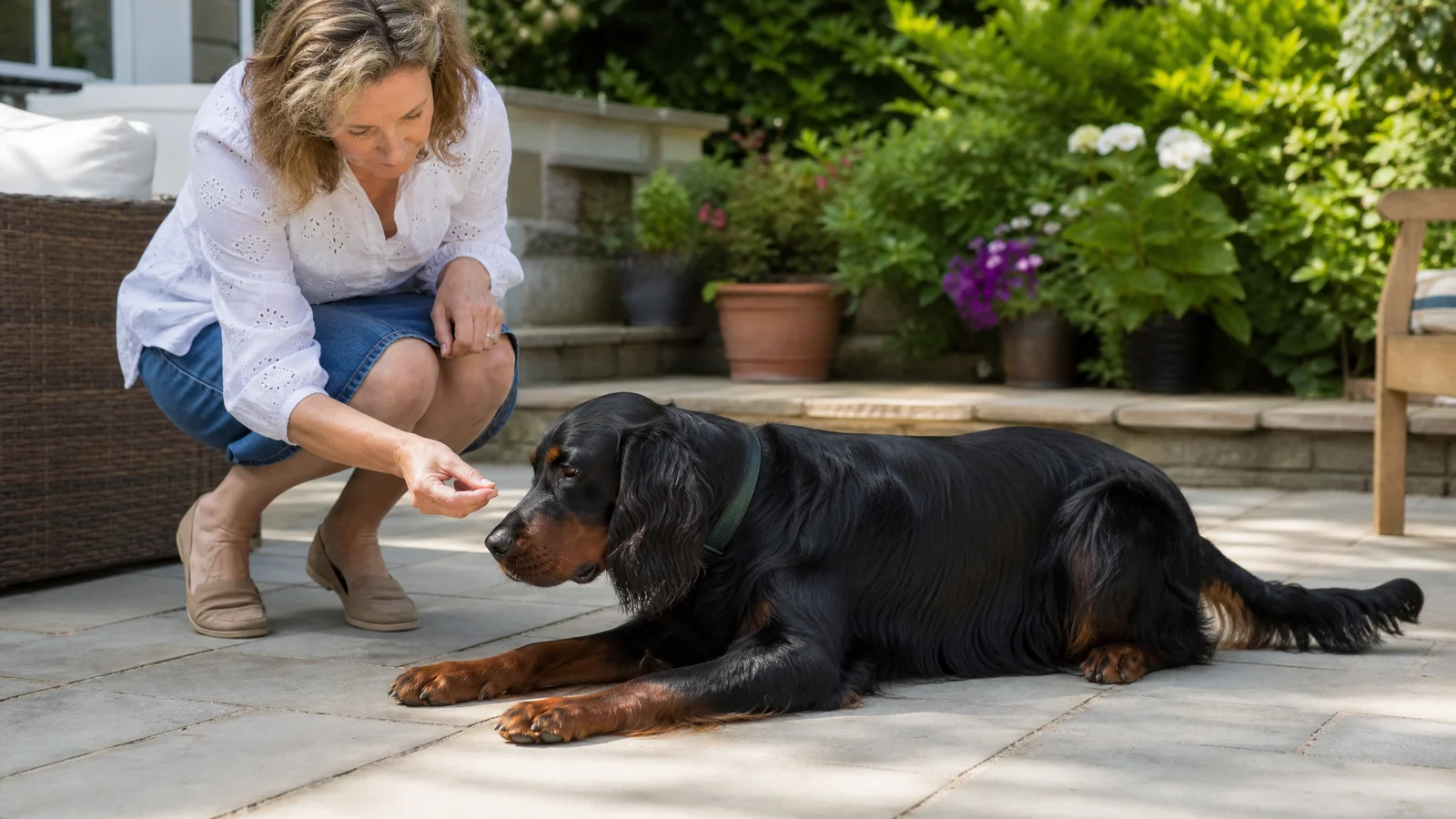
Yes, you can train a Gordon Setter very well, and patient, reward-based teaching kept up over years is how. The breed is smart and quick to learn, but also stubborn and unresponsive to heavy hands, so the way you teach counts for more than how fast the dog picks things up.
That matters because their energy and strong opinions turn into trouble mainly where training and exercise are missing. Owners who supply both describe a manageable, often relaxed dog, and after a long time spent on this breed's behavior and training, we see that pattern hold.
Read on for seven common beliefs about Gordon Setter training, from stubbornness and heavy-handed obedience to recall, slow maturity, socialization and treats, ending with a plan for your next two weeks.
Stubborn Does Not Mean Untrainable in Gordon Setter Training
A Gordon Setter learns sit in a single afternoon, then stares past you at a squirrel in the park as if the word had never been spoken. It looks like stubbornness. Usually the dog has forgotten nothing. They have found something more interesting than you, which is a focus problem and not a learning problem.
Breed ratings put trainability at 5 of 5, and the breed is described as very smart and quick to learn. The same description calls Gordons stubborn yet very soft and loving, dogs who live to please their owner. Those two pictures do not conflict. A dog can understand exactly what you asked and still weigh it against everything else in the air.
The breed standard adds that the Gordon is strong-minded enough to stand the rigors of training. Read that as good news. A strong-minded dog takes plenty of repetition without wilting, but wants the work to make sense and the payoff to be worth it.
Many owners describe their Gordons as very trainable and also very distractible and driven. So the real work is building focus around interesting things, not teaching the behavior itself. Our look at Gordon Setter trainability and temperament goes deeper on this.
Build Focus in This Order
Teach every new skill in the sequence below, and do not move to the next step until the dog succeeds at the current one.
Start by teaching the behavior in a quiet room with no competition, then pay generously for eye contact and for checking in with you, so that looking at you becomes a habit. Next, add one distraction at a time, starting mild, such as a toy lying on the floor. Then move to a new place and lower your expectations for the first few repetitions. Save the best rewards for the moments when the dog chooses you over the most interesting thing around.
Do Gordon Setters Need Heavy-Handed Training?
Give a Gordon Setter a sharp tone and a rapid string of commands, and you will often see the dog slow down, look away or find something else to do. Some owners who expected the talk of this breed's sensitivity to be hype find it is genuine, and the dog simply stops offering effort.

The breed's parent club says young Gordons can be trained without breaking their spirit when the techniques are right, and that they do not respond well to heavy-handed obedience. Research points the same way. Several survey studies found higher obedience in dogs trained with reward-based methods.
Stress tells the same story. In a 2020 PLOS ONE comparison of 92 pet dogs, those attending reward-based schools showed fewer stress behaviors, more relaxed postures, less panting and smaller cortisol rises after sessions.
So the belief is half right. Gordons do need structure, but it belongs in your routines and not in your hands or voice. Consistent means the rules do not change from day to day, every family member uses the same cues, and good behavior gets paid reliably.
Consistency in Daily Habits
Consistency is a set of habits you can practice, and these matter most.
Use a marker word such as yes the instant the dog does what you wanted, then deliver the treat, so they know exactly what earned it. Agree on one set of cue words and household rules with everyone at home, and keep them the same on tired days.
Manage the setting so the wrong choice is hard to make, with a gate, a leash or a closed door. When the dog gets it wrong, make the next attempt easier instead of louder, and if play gets too rough, stop the game and give a short, calm break before starting again.
Recall Training Is Not a Lost Cause for Bird Dogs
Many owners report that a Gordon's verbal recall is generally pretty good in ordinary moments, stubborn at times, and likely to vanish when a bird or squirrel breaks cover. That pattern feeds the belief that a dog bred to find birds simply cannot be called back.
The belief goes too far. Recall can be built with this breed when you do it in stages and pay well, and the Gordon has one point in their favor: the UKC standard describes them as not as wide working or as speedy as some other pointing breeds. What recall cannot do is cancel a nose and an instinct, so treat it as one layer of safety with management as the other.
Build Recall in This Order
Work through these steps over weeks, not days, and keep the rewards high at every stage.
- Choose one recall word and use it only for happy things, never for baths, nail trims or the end of the fun.
- Practice indoors first, rewarding every return with a treat the dog loves.
- Move to a fenced yard and add distance, calling when the dog is already turning toward you.
- Switch to a long line in a safe open space, so the dog cannot rehearse running off.
- Add distractions one at a time, and pay the biggest rewards for leaving the most interesting ones.
- Now and then call the dog, reward them, and release them back to sniffing, so that coming to you does not always end the fun.
When Management Does the Heavy Lifting
Gordons should never be allowed to roam freely, because the nose goes to the ground and the urge to follow a bird or squirrel can carry them across a busy highway. Many owners whose Gordon chases birds and small animals at a full sprint stop relying on recall in open places.
They use a fenced area, or a non-retractable leash everywhere else, and save recall practice for training and for the moments it counts. That is not failure but a sensible split. For the instinct behind the chasing, see common Gordon Setter behavior problems.
Slow Maturity Stretches Training Past Year One
History records that the Duke of Gordon would not shoot over his setters until they were 5 years old, because they were very wild when young and slow in maturing. Few modern owners wait that long, but the lesson stands: this breed takes its time growing up.
That is why the belief that training is finished at one year causes so much grief. Gordons stay puppy-like, and highly intelligent, for a long while. Behavior you taught carefully can seem to disappear in adolescence, and the fix is to go back to basics, raise the reward value, shorten the sessions and add distractions in small steps.
Owners also report that Gordons train very successfully, but skills hold when training is consistent and refreshed from time to time, not taught once and assumed finished. Where owners give durations, they describe multi-year efforts, so plan to keep short daily sessions going for years rather than weeks.
Refresh One Skill a Week
Refreshers fit easily into normal days. Pick one item from this list each week and give it a few rewarded repetitions.
Try loose-leash walking on a busier route than usual, or recall on a long line in a place the dog does not know well. You can also practice settling on a mat while you eat a meal, ask for four paws on the floor when visitors arrive, or try leave it with a tougher item than last time. Stays with a little more distance work well too.
Energy is rated high for the breed, and the need for mental work is rated high too, so training sits beside exercise and not in place of it. Owners say their Gordons enjoy hiking and walks but are also content to be lazy, so you do not need to keep them constantly busy. Keep up regular veterinary visits through the long growing-up period, and if house training is still in progress, our guide to potty training a Gordon Setter fits the same routine.
Is Socialization Optional for a Quiet Gordon Setter?
A Gordon puppy who watches visitors calmly from the edge of the room can look like a finished product. Gordons tend to be devoted to their household and not overly friendly to strangers, and they tend to tolerate attention from unknown people rather than seeking it. It is easy to decide that a quiet dog needs no introductions.
That belief gets it backwards. Tolerating a stranger is not the same as being comfortable with one, and a reserved dog has the most to gain from early, positive exposure. Early socialization and puppy classes are recommended for the breed to help them grow into well-adjusted, well-mannered companions.
Breed ratings show a middle path. Openness to strangers is rated 3 of 5, which is ambivalent, and getting along with other dogs is rated 3 of 5, which means with supervision. Sensitivity raises the stakes. Fear that is already established takes patience to undo, because the work is lowering the fear first, and owners of fearful rescues describe progress measured in years rather than weeks.
A Socialization Checklist
Pair every new experience with treats, let the puppy choose their distance, and stop before they are overwhelmed.
- Let the puppy meet calm visitors at their own pace, with treats appearing whenever someone new walks in.
- Introduce different surfaces, sounds and places in short outings that end on a good note.
- Arrange supervised meetings with calm, friendly adult dogs instead of crowded free-for-alls.
- Introduce children early, since children and Gordons are a good combination when the dog meets them young.
- Practice short stretches alone, because Gordons bond closely but are fine alone when the family is away. Our guide to Gordon Setter crate training and separation anxiety covers the steps.
Teach children to respect the dog as a household member. When a child keeps teasing, a Gordon will tend to remove themselves rather than growl, so watch for the quiet exit and give them somewhere to go. Many Gordons also become talkers, and socialization teaches them that most visitors are good news.
Food Rewards Do Not Spoil Gordon Setter Training
Breeders of show-bench Gordons report dogs who are food motivated, and you will see it in the first session, when the whole body tilts toward the treat pouch. Some owners worry this will produce a dog who only works when food is visible.
The worry is common, but reward-based training does not work that way. The RSPCA's guidance is that all training should be reward based: pay with food, a toy or praise the dog values, and the behavior you paid for comes back more often. For a dog with a ready food drive, treats are simply the clearest way to say yes.
Treats go wrong only when they turn into a bribe shown before the dog has done anything. The fix is order and variety, not removing food.
Using Treats Well
Keep treats small, soft and smelly, so the dog swallows quickly and goes straight back to work, and keep the treat out of sight until the dog has done the behavior, then reward right away. Vary the payment, with sometimes one treat, sometimes several, and sometimes a life reward instead.
Life rewards such as a sniff, going through a door or being released to run suit a nose-driven breed especially well. Save the best treats for the hardest jobs, like coming away from a distraction.
Your Gordon Setter Training Plan for Two Weeks
Gordons reward short, consistent work, so a plan that fits into daily life beats a heroic weekend. Aim for a few brief sessions a day that add up to roughly 15 to 20 minutes, with walks and play on top. Week one builds foundations in quiet places, week two adds distractions in small steps, and every session should end on a win.
- Day one: choose your marker word and your best soft treats, then mark and reward eye contact in a quiet room.
- Day two: teach sit and down with treats, and start settling on a mat while you eat.
- Day three: practice loose-leash walking indoors and in a yard, rewarding the dog for staying beside you and ending with a sniff release.
- Day four: begin recall indoors with your chosen word, paying your biggest treats for every return.
- Day five: repeat everything in a new room or a fenced yard to see what holds up.
- Day six: practice greetings, rewarding four paws on the floor and calm behavior when visitors arrive.
- Day seven: rest from formal work, take a long sniffing walk, and note which skills need more attention.
- Day eight: practice recall on a long line in a quiet, safe place.
- Day nine: add mild distractions to sit and down, such as a toy on the floor or a family member walking past.
- Day ten: walk a familiar route and pay for attention whenever something interesting appears.
- Day eleven: practice settling where there is activity, such as the kitchen at dinnertime.
- Day twelve: build a short stay with a little distance and a clear release word.
- Day thirteen: practice a calm greeting with a friendly visitor or a calm dog at a comfortable distance, with treats for relaxed behavior.
- Day fourteen: review, pick the one skill that needs the most work, and make it next week's refresher.
When the two weeks end, keep the rhythm going. This is a smart, driven, stubborn and sensitive breed, and those traits stay manageable when you supply patient, reward-based training and enough exercise year after year. Treat the plan as the start of a long habit, not a course you finish, and you will have the relaxed, willing family dog who experienced Gordon people describe.
 Training basicsGordon Setter Leash Training: Stop Pulling and Lunging
 BehaviorSocializing a Gordon Setter With Kids, Dogs and Strangers
 Exercise and jobsNose Work and Tracking for Gordon Setters