 Gordon Setter
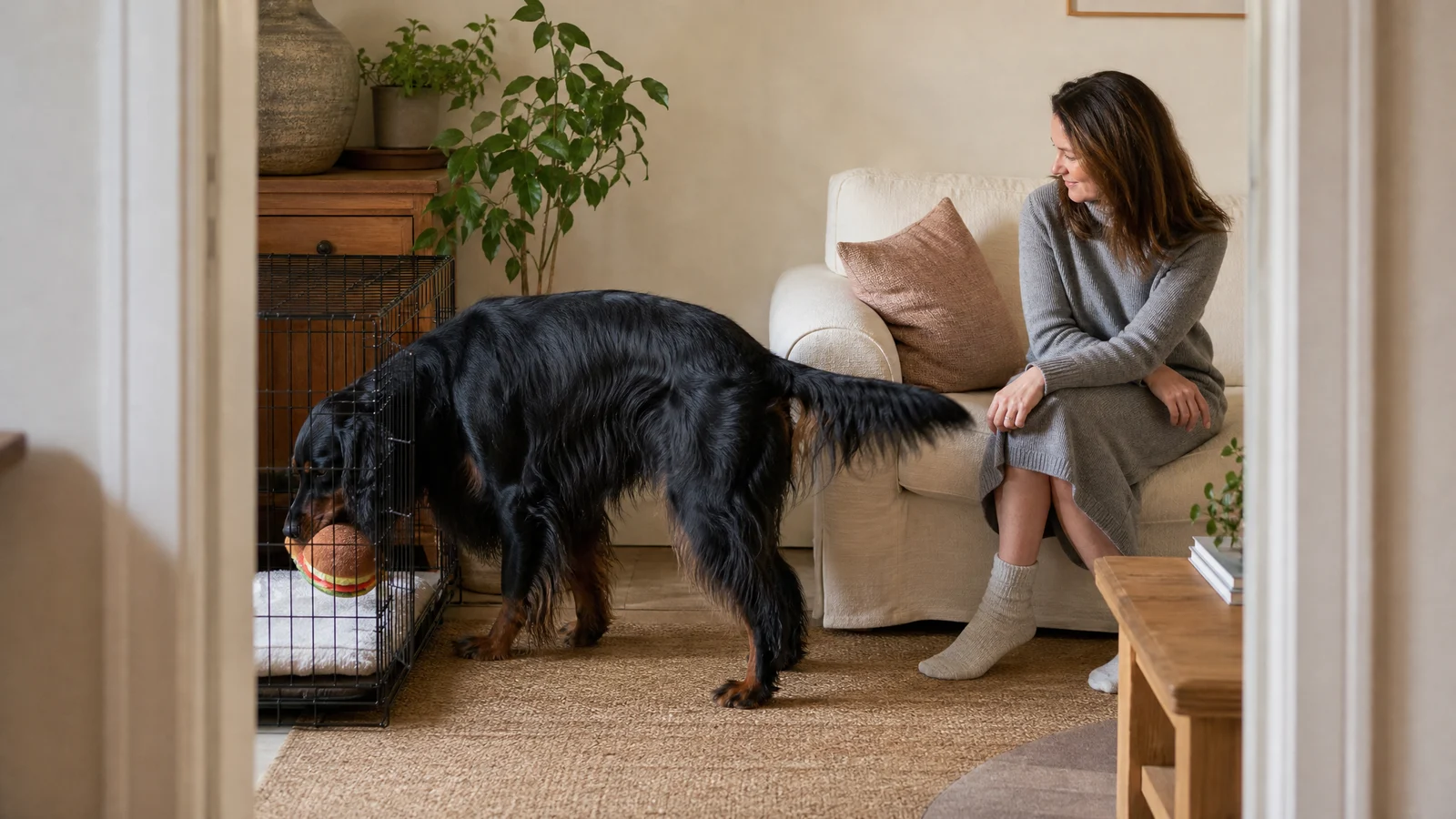
Some Gordon Setters settle easily when the family is out, resting on the crate bed and greeting everyone calmly at the door. Others struggle, pacing, crying and drooling until someone returns.
Gordons who get steady, moderate activity such as walks and hikes are described as content to relax afterward, without constant engagement. Reports point to handling as the deciding factor in whether a Gordon's energy and stubbornness become problems, since owners who give training and exercise describe a manageable, relaxed dog.
The gap matters because Gordons bond hard, and a dog who has never practiced being apart cannot know the absence ends. Calm alone time here is taught, not automatic, and a crate that means rest is the easiest place to teach it. This guide covers crate training and alone time for a Gordon Setter, from the first sniff of an open crate to a full workday, and from ordinary settling-in fuss to the signs that call for help.
Two Gordon Setter Households
The difference between those households is rarely luck. Gordons are athletic and outdoorsy yet sweetly affectionate by the fireside, so a dog given steady, moderate exercise has somewhere to put their energy and is free to switch off afterward. Many owners find they never had to keep the dog constantly engaged. A Gordon with unspent energy tends to pour it into the crate door.
Handling is what owner reports keep returning to. Energy and stubbornness turn into problems when exercise and training are lacking, while owners who supply both describe a manageable, relaxed dog. That makes daily Gordon Setter loose-leash walking part of crate training, not a separate chore.
Then there is the bond. The AKC says Gordons are closely bonded to their family and live to be with them, yet are fine alone when the family is away. Both can be true, but the second half has to be taught. The breed standard calls the dog loyal and strong-minded enough for training, and Gordons learn quickly, so calm absences are within reach when the steps are small.
The plan below keeps that claim true in four stages. The crate becomes a bedroom, the door closes while you stay close, the distance grows, and then you deal with the protest many dogs offer along the way. We have trained this breed for many years, and the order matters more than the pace, because a Gordon who feels safe at each stage moves faster than one who is hurried.
Making the Crate a Bedroom
The first stage has one job: teaching your Gordon that the crate predicts good things and asks for nothing. Dogs judge a place by what happens there, so a crate whose first lesson is a closing door comes to mean being parked while the family carries on without them. For a breed that lives to be with its people, that lesson stings, and it can color every later stage.
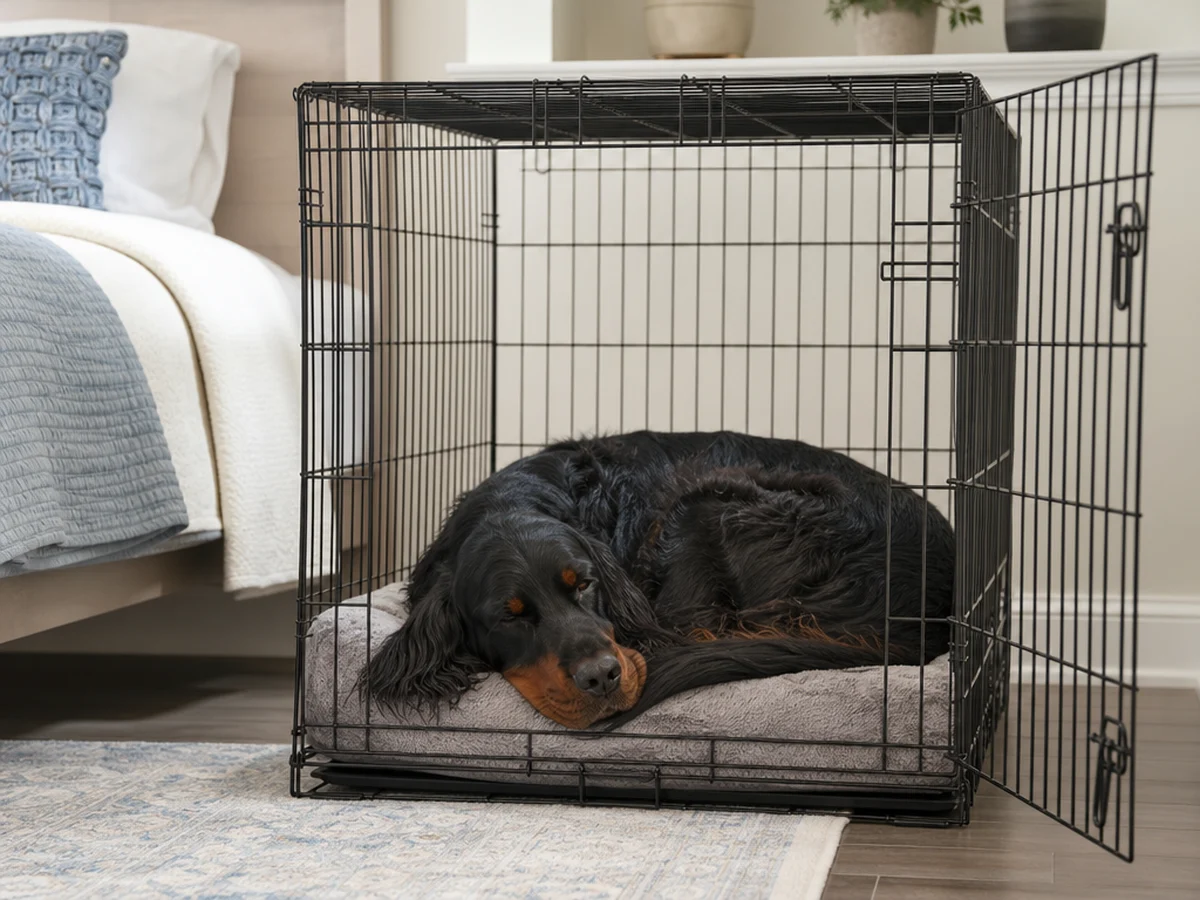
Build the opposite association first, and shut nobody in yet. Expect this stage to take several days, longer for an anxious or very young dog.
Location and Bedding
Put the crate where the family spends its evenings, such as the living room. A Gordon devoted to the household rests more easily within sight and sound of everyone, while a crate in a basement or spare room can read as exile, and the protest that follows is about loneliness, not stubbornness. Keep it out of drafts and direct sun, and add a washable bed.
Size matters for a growing puppy. Too much floor lets a corner become a toilet, so use a divider panel in a larger crate and shift it back as the puppy grows. Gordons mature slowly, so expect to adjust it across a long adolescence.
Meals and Chews Inside
Meals are the quickest bridge to a good feeling about the crate. Feed beside it first, then at the threshold, then inside over several days, so the dog meets the crate during the best part of their day. Move the bowl only as fast as their comfort allows, since a rushed step turns the best part of the day into a test.
Chews do the same work between meals. A stuffed toy or a safe chew sized for your dog gives them a reason to linger, and rotating a few keeps the crate interesting. Scattered treats and food puzzles let a dog bred as a bird dog use their nose, which tires a Gordon in a useful way and makes lying down the natural next move.
Letting Your Gordon Wander In
With the door fastened open, drop one treat on the floor beside the crate, a later one on the threshold, and a later one on the bed at the back, and let the dog discover the path. When they step in on their own, say a marker word, a short word such as yes that tells them exactly which moment earned the reward, then deliver the treat. A dog who chooses the crate learns something a lured or pushed dog never does.
If your Gordon hesitates, go back a step and make the reward easier to earn, because a soft-natured dog learns best when each step feels safe. Gordons also tend to remove themselves from teasing rather than growl, so teach children that the crate is the dog's room: nobody reaches in, climbs in or calls them out. That makes it the polite place to retreat when play gets to be too much.
Closing the Crate Door
Stage two introduces the door, and the aim is to make it dull. Closing a door is the first moment of real restriction, so keep each stretch short and stay in the room, where your calm presence shows the dog that nothing bad is happening. Gordons are smart and learn quickly, which cuts both ways: they pick up on a worrying door as fast as a pleasant one.
Take off collars and tags, ask your Gordon in, give a treat, close the door and sit beside the crate. Open it before any fuss begins, then repeat with the gaps lengthening in small, uneven steps. A stuffed chew handed over as the latch clicks gives them something better to do than watch you. Do this after a walk, when rest is the natural next thing.
Judging readiness is mostly a matter of watching bodies, not clocks. Move on only when these signs show up across several sessions in a row, and treat one good session as luck, not proof.
- The dog walks into the open crate on their own and settles, instead of grabbing a treat and leaving.
- Their body looks loose while the door is closed, with a soft face, a sigh or a lowered head.
- They keep working on a chew behind the closed door instead of staring at you.
- When you open the door they stay a moment or stroll out calmly, rather than bursting through.
- They go back to the crate later without being asked.
When a sign slips, you moved too fast, so shorten the stretch, reward the calm and rebuild. Gordons do not respond well to heavy-handed obedience, and the complete training guide shows the reward-based habits that keep this stage gentle. Only when a closed door is boring with you beside the crate should you start moving away.
Teaching Gordon Setter Alone Time
Stage three stretches the distance, and it is where the bond and the calm-when-alone description have to be reconciled. A dog attached to the family has more to lose when you leave, so a sudden long absence feels like an emergency, and a dog in an emergency learns fear instead of patience.
The fix is to keep each absence shorter than the time worry takes to start, which trainers call staying below threshold, meaning under the point where worry begins. Do that consistently and the closely bonded dog and the dog who is fine alone become the same Gordon, because leaving has always ended in your return. Dogs vary, so we cannot promise a timeline.
Stepping Out of Sight
Start inside the house with the dog resting on a bed or in the open crate while you move around the room, and reward that calm. Then step behind a door or a baby gate, come back before they fuss, and reward again. Keep your return quiet, because a big greeting builds excitement that makes the next separation feel sharper. Vary the lengths so they cannot predict them.
Leaving the House Briefly
Pick up your keys and put on shoes now and then without leaving, so those cues stop meaning you are gone. Offer a walk, sniffing time and a little training first, then hand over a stuffed chew, leave quietly and come back before the dog gets upset. A phone recording shows what really happens after the door closes, and whether they are resting or only waiting.
Building Up to a Workday
A workday is a long gap, and the crate is for rest, not storage, so the build-up should include a plan for hours the dog cannot yet manage. Lengthen absences in uneven steps over weeks, not days, and expect an adolescent Gordon to wobble, since this breed matures slowly and stays puppy-like for a long time. A gated room with a bed can suit longer absences once they are reliably calm.
Gordons adapt to many living situations when they are sure of their family's love, so a midday visit from a friend or walker is a fair bridge while skills grow. Keep exercise steady rather than extreme. Owners report that moderate daily activity produces a dog who can lie down and wait.
When the Crate Gets Noisy
Noise is the stage most owners dread, and it helps to know why it happens. Gordons live to be near their people, so a closed door with you on the far side is a real gap, and protest is a natural way to say so. Many Gordons are also talkers with a vocabulary of tones, so sound alone does not mean distress. What matters is how the sound and the body behave together.
Whittling Down the Whining
For ordinary fuss, change what earns attention. Reward the pauses by dropping a treat through the bars or opening the door during a moment of quiet, so quiet becomes the key. Then ask for a slightly longer quiet before the reward. Opening the door at the peak of protest teaches that noise works, so wait for a break, even a brief one, and keep your voice flat and your face boring while you do it.
Fuss or Real Distress
This comparison helps you sort settling-in fuss from real distress, though any single sign needs the whole picture around it.
| Sign | Settling-in fuss | Real distress |
|---|---|---|
| Sound | Whines, huffs or chatter that rises and falls | Barking or howling that builds and does not ease |
| Body | Loose, shifting, then lying down | Panting, drooling, pacing or frantic scratching |
| Recovery | Settles within a short while | Stays escalated or gets worse |
| Food | Takes a treat or chew | Refuses even a favorite |
| Toileting | Stays clean | Toilets indoors despite being house trained |
Real distress calls for a different plan. A crate will not settle genuine panic, and a dog with separation anxiety may soil the space, howl for hours or injure themselves trying to escape, so a dog-proofed room is the safer choice. While you work on the problem, avoid leaving them alone except during planned practice sessions. Most affected dogs cope well when any person is nearby, and that person does not have to be you.
As for how often it happens, breed descriptions do not single out separation trouble in Gordons, and owner reports lean toward calm dogs when exercise is steady. We have no reliable rate, so treat it as something to watch for, not something to expect.
Going Back a Step
If your dog is truly panicking, end the session gently and make the next one shorter than the one that went wrong. Return to the last length they handled calmly, hold it until they are relaxed again, then move forward more slowly. Going back is part of the method, not a failure, and an adolescent Gordon may need it several times.
Call your veterinarian if signs appear suddenly in a dog who was comfortable, or if they hurt themselves or stop eating, since pain or illness can look like a behavior problem. Regular vet visits through adolescence help catch changes early, and your vet can refer you to a qualified behavior professional who uses reward-based methods.
Today's One Crate Step
A closely bonded, slow-maturing Gordon does not need a perfect schedule or constant entertainment. They need steady walks, a crate that has only ever meant rest, and absences taught in pieces small enough to stay calm through. Do that, and the picture of a dog who is both devoted and fine alone stops being a contradiction and becomes your dog.
So skip the big plan today and do one small thing. After a walk, when your Gordon is ready to settle, fasten the crate door open, put one chew inside, and let them rest there for five minutes while you stay close.
 Puppy trainingGordon Setter Puppy Biting, Chewing and Wild Puppy Energy
 Puppy trainingGordon Setter Puppy Training Timeline: 8 Weeks to 2 Years
 Training basicsRecall for a Gordon Setter: Birds, Squirrels and the Nose